
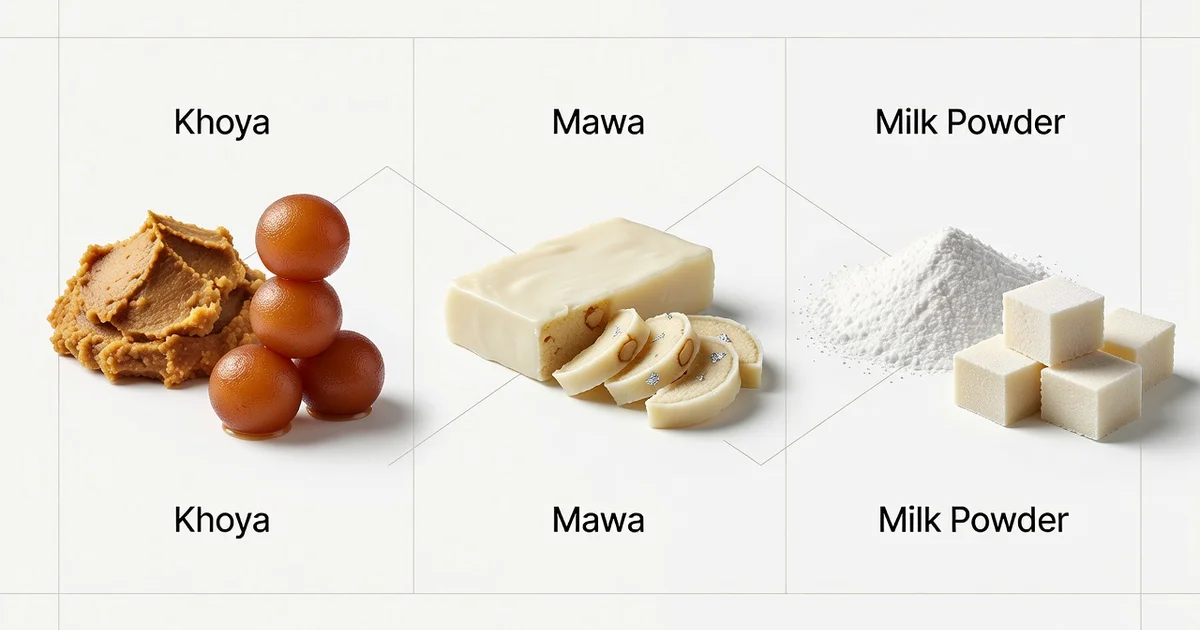
If you have ever followed a classic Indian sweet recipe, you have probably paused at the ingredient list and wondered whether khoya, mawa, and milk powder are actually the same thing. They are not, and knowing the difference can make or break your gulab jamun, barfi, or peda.
This guide breaks down the difference between khoya, mawa, and milk powder in sweets, explaining how each one is made, how it behaves during cooking, and when to substitute one for another. By the end, you will know exactly which ingredient to reach for and why it matters.
Introduction
Walk into any Indian sweet shop, and you will encounter three ingredients that quietly shape almost everything on display: khoya, mawa, and milk powder. To a casual observer, they seem interchangeable—all are milk-derived, all are white or off-white, and all end up in the same glass case next to barfi and gulab jamun. Yet the difference between khoya, mawa, and milk powder in sweets is not a trivial detail. It determines texture, shelf life, sweetness, and whether your homemade barfi turns out chewy and rich or dry and crumbly.
Many home cooks and small-scale confectioners use these terms loosely, often assuming khoya and mawa are separate products and that milk powder is a simple substitute. That confusion leads to disappointing results: a peda that refuses to hold its shape, a halwa that tastes flat, or a mithai that spoils within a day. This article explores the difference between khoya, mawa, and milk powder in sweets with clear, practical guidance so you can choose the right ingredient for the right job.
Understanding the fundamentals of khoya, mawa, and milk powder—how each is made, what it does to a recipe, and where it falls short—helps you make informed decisions. Reliable information and consistent habits lead to better long-term outcomes, whether you are preparing sweets for a festival, a family gathering, or a small business.
Key Concepts
Before comparing the three, it helps to define each ingredient precisely.
Khoya
Khoya is made by slowly simmering full-fat milk in a wide, heavy pan until most of the water evaporates. The result is a soft, moist, granular solid with a fat content typically between 20 and 30 percent. Because it is essentially concentrated milk, khoya carries a rich, cooked-milk flavor and a slightly grainy body. Its moisture level is the highest of the three, which is why it feels pliable and melts in the mouth.
Mawa
Here is the fact that surprises many people: mawa and khoya are the same thing. The words are regional synonyms. In North India and among many Hindi speakers, the product is commonly called khoya; in parts of western India and in many commercial kitchens, the same reduced-milk solid is called mawa. Any recipe that lists both is either repeating itself or using “mawa” to mean a slightly drier, more roasted version of the same base. For practical purposes, treat khoya and mawa as interchangeable, and judge quality by moisture, grain, and smell rather than by the label.
Milk Powder
Milk powder is a completely different product. It is made industrially by evaporating milk to dryness using spray-drying or roller-drying, producing a fine, shelf-stable powder with roughly 3 to 5 percent moisture. It is not reduced milk in the traditional sense; it is dehydrated milk. Reconstituted with water, it approximates liquid milk, but it lacks the cooked, caramelized notes and the fat structure that develop during slow simmering. In sweets, milk powder acts as a thickener, a binder, and a source of milk solids—not as a true replacement for khoya.
Deep Dive
The practical differences show up in four areas: texture, flavor, behavior during cooking, and shelf life.
- Texture: Khoya gives sweets a dense, moist, slightly chewy bite—think classic milk barfi or gulab jamun. Milk powder tends to produce a drier, firmer, more uniform set, which can be pleasant for quick pedas but lacks the melt-in-the-mouth quality of khoya.
- Flavor: Khoya tastes of slowly cooked milk, with subtle nutty and caramel notes. Milk powder tastes flat and faintly powdery unless it is cooked with ghee, sugar, and flavorings that mask its processed character.
- Cooking behavior: Khoya must be cooked gently. High heat makes it split or burn, releasing fat and turning grainy. Milk powder, by contrast, is far more forgiving; it dissolves into a mixture and thickens quickly, which is why it is popular in no-fail recipes and commercial production.
- Shelf life: Fresh khoya is perishable and typically keeps only a few days refrigerated. Milk powder is shelf-stable for months, and sweets made from it often last longer than khoya-based ones because they contain less moisture.
Many commercial sweet shops blend the two. A base of khoya provides richness and authenticity, while a small proportion of milk powder improves yield, structure, and shelf life. This is not cheating—it is formulation. Knowing the difference lets you decide when to accept that trade-off and when to insist on pure khoya.
One more distinction matters: milk powder is not the same as milk solid or dairy whitener. Some brands add sugar, stabilizers, or vegetable fat, which changes how the powder behaves in a hot pan. Always check the ingredient list before substituting.
Step-by-Step Guide to Choosing and Using These Ingredients
Step 1: Understand the fundamentals
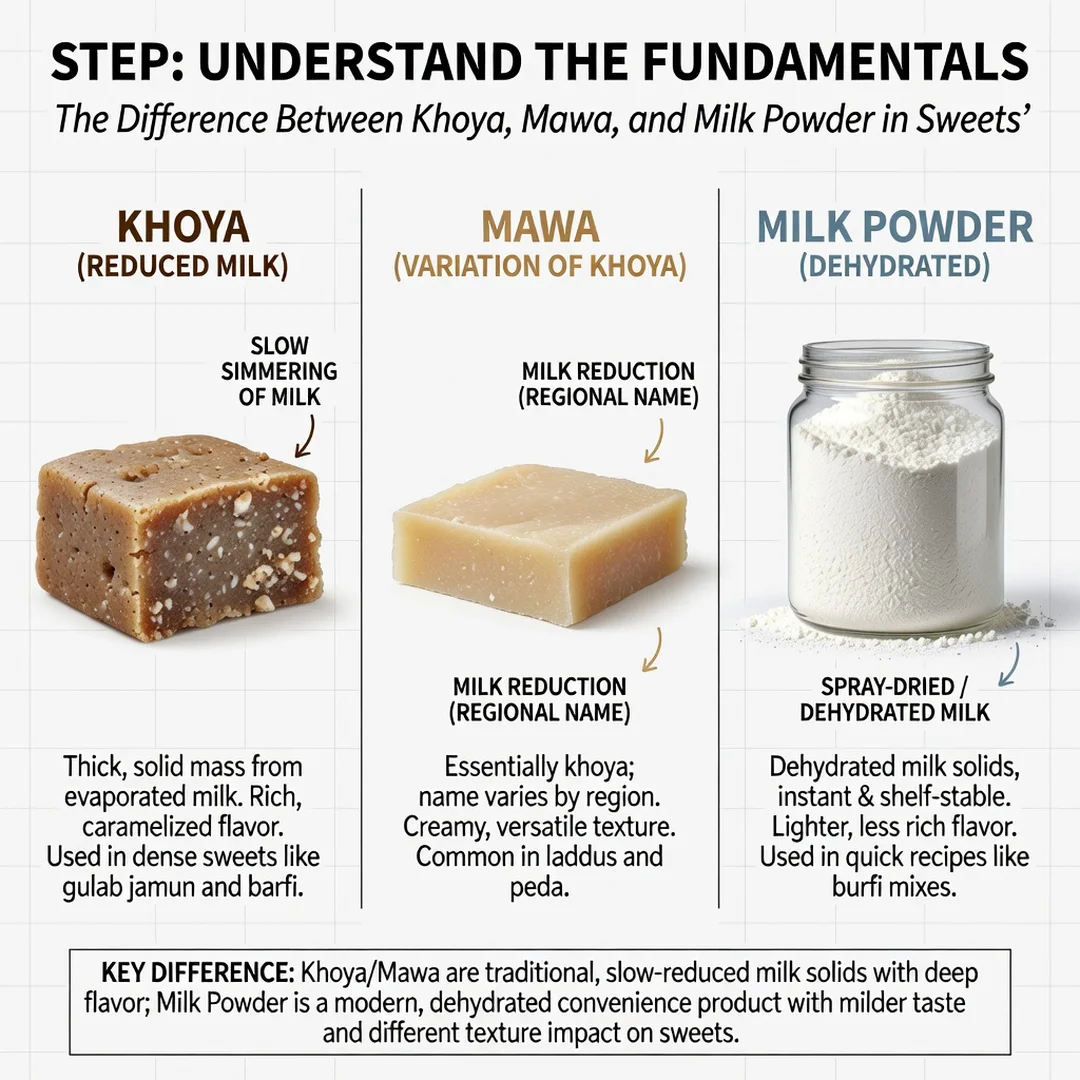
Commit to memory that khoya and mawa are the same reduced-milk solid, while milk powder is dehydrated milk. This single fact prevents most recipe errors. If a recipe calls for mawa and you have khoya, proceed confidently. If it calls for khoya and you only have milk powder, expect a different result and adjust your method accordingly.
Step 2: Assess your starting point
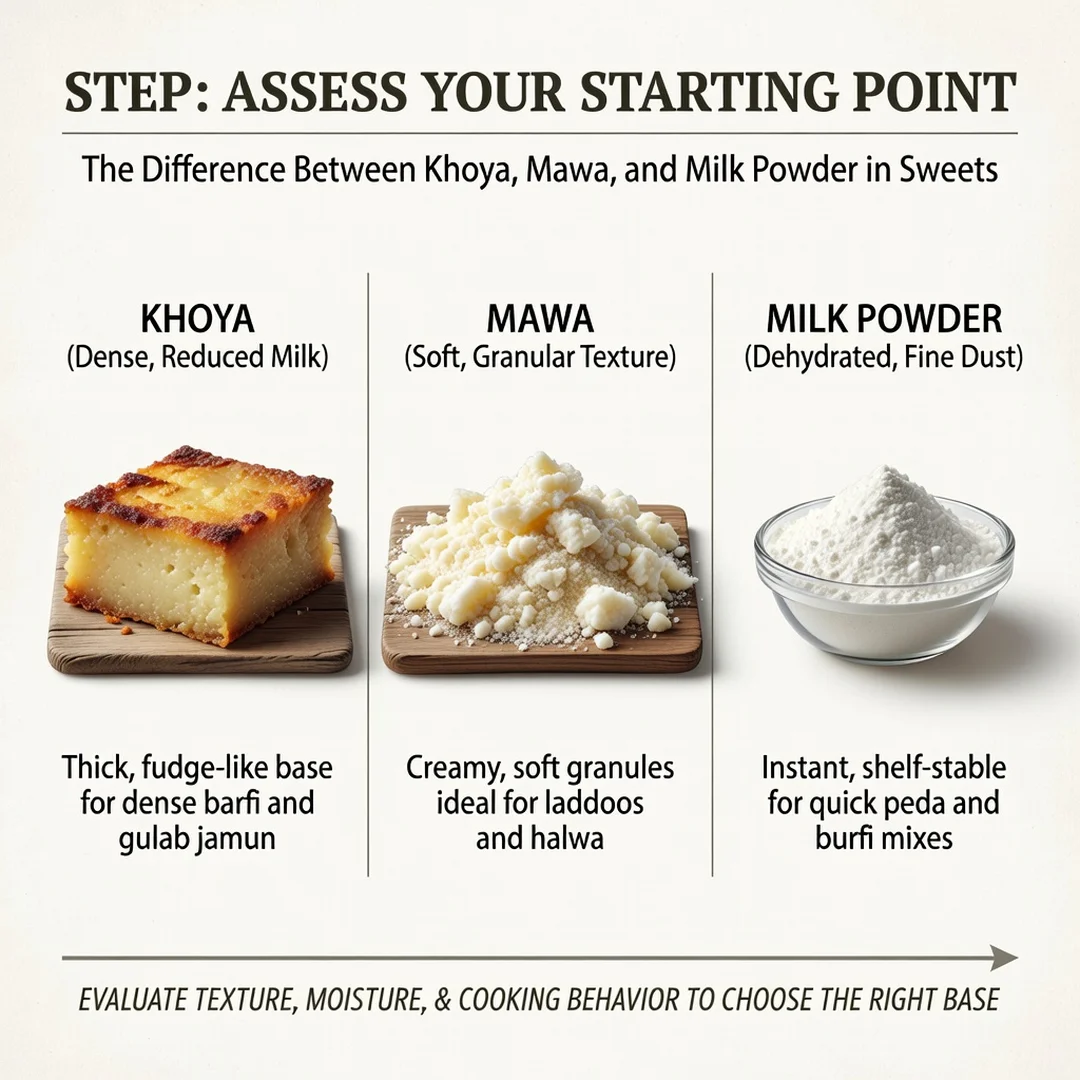
Look at what you actually have. Fresh khoya should be moist, smell pleasantly of cooked milk, and show a fine grain without free fat oozing out. If it is crumbly and dry, it has been over-reduced. Milk powder should be free-flowing with no clumps or off smell. Note your equipment too: a heavy-bottomed pan or nonstick kadai is essential for khoya, while milk powder recipes are more tolerant of ordinary cookware.
Step 3: Set clear goals
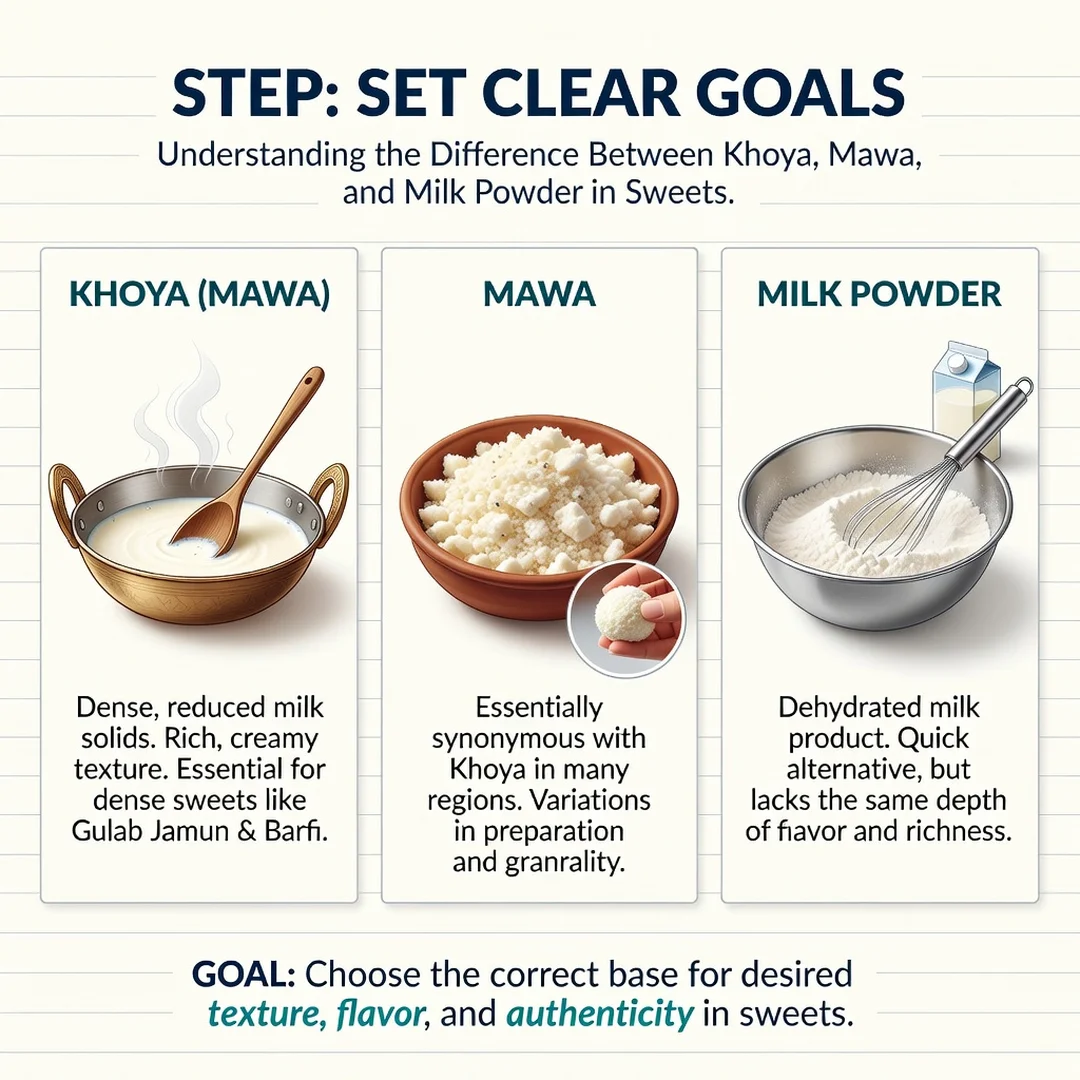
Decide what matters most for your sweet. If you want authentic flavor and a soft bite for a festival, prioritize khoya. If you need speed, consistency, and longer shelf life for a large batch or a sale, milk powder—or a blend—may serve you better. Write down your target texture and storage time before you begin, because these goals dictate the ingredient.
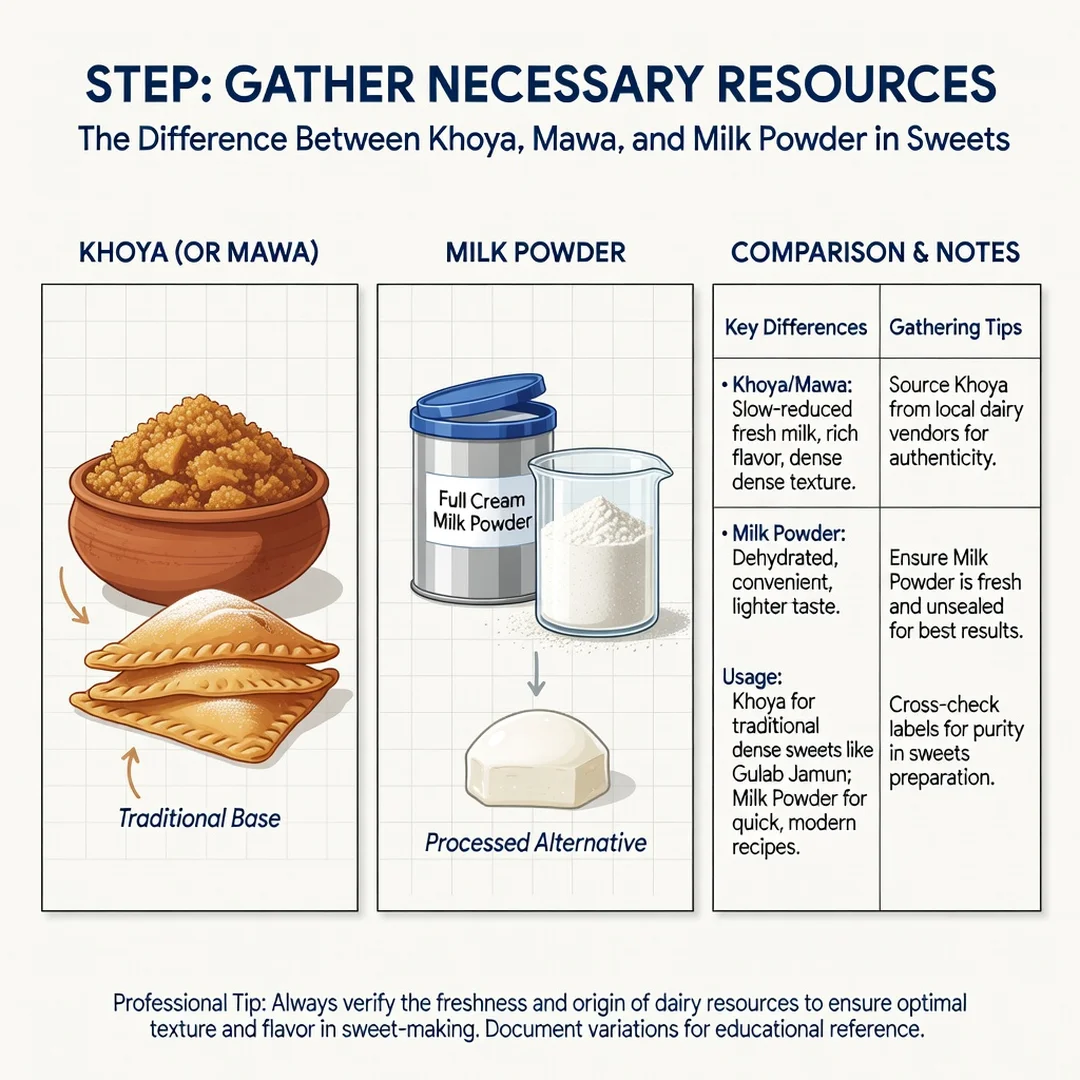
Step 4: Gather necessary resources
For khoya-based sweets, gather full-fat milk or fresh khoya, ghee, sugar, cardamom, and a heavy pan with a sturdy spatula. For milk powder sweets, you will need good-quality milk powder, ghee or butter, sugar, milk or cream for binding, and flavorings. A kitchen scale helps, since milk powder recipes are less forgiving of eyeballed ratios. If blending, plan roughly 70 percent khoya to 30 percent milk powder as a starting point.
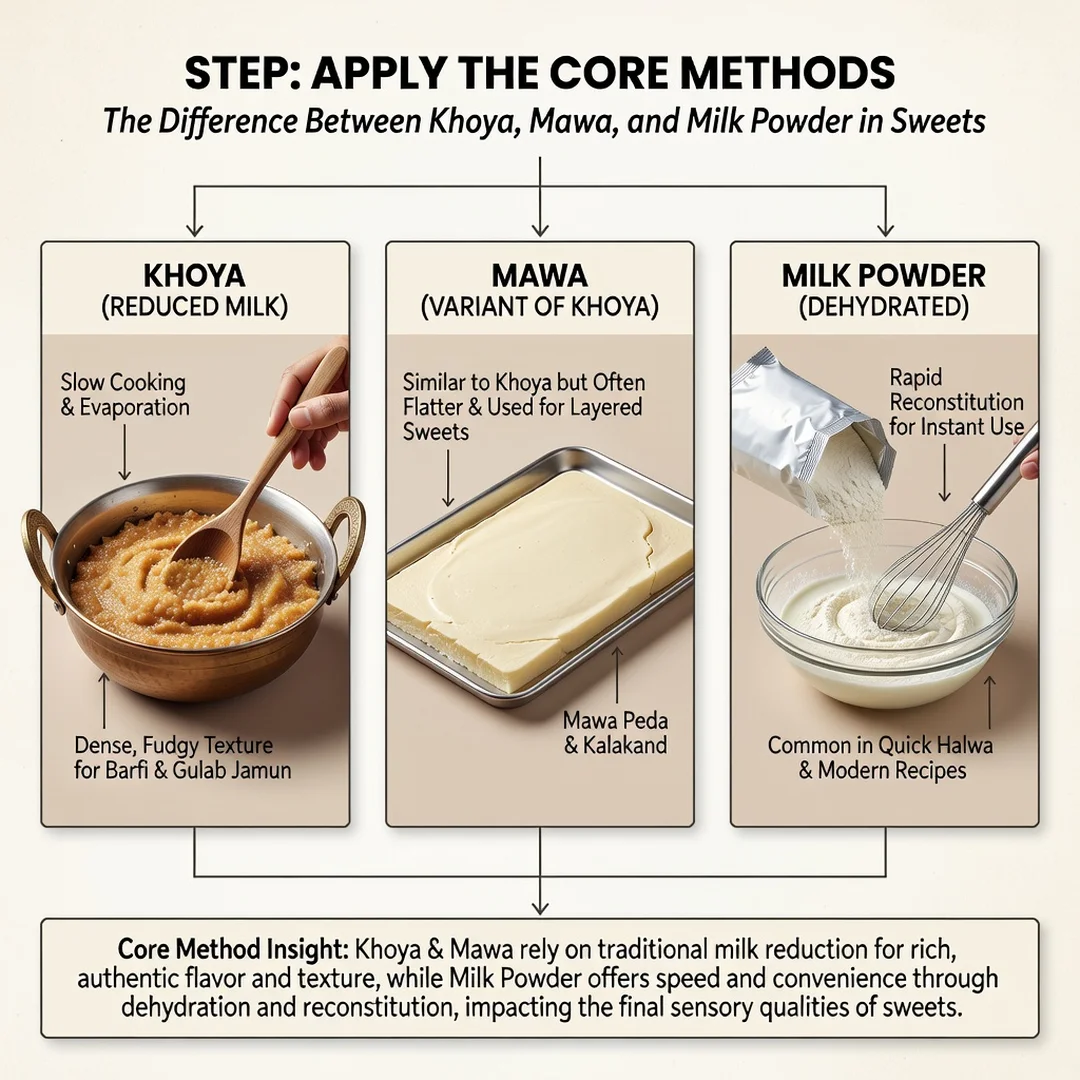
Step 5: Apply the core methods
With khoya, cook on low heat, stirring continuously, and add sugar only after the khoya softens and releases a little fat. Stop when the mixture leaves the sides of the pan. With milk powder, first warm the ghee or milk, then sift in the powder to avoid lumps, and cook briefly—overcooking makes it rubbery. For a blend, cook the khoya first, then fold in the milk powder at the end. In every case, cool slightly before shaping, and store finished sweets in an airtight container away from moisture.
Best Practices
- Buy khoya from a trusted source or make it at home; adulterated khoya often contains starch or skim-milk solids.
- Refrigerate fresh khoya and use it within two to three days, or freeze it for up to a month.
- Choose full-fat milk powder without added sugar or whitener for sweet-making.
- Always sift milk powder before use to prevent lumps.
- Keep the heat low for khoya and moderate for milk powder; high heat ruins both.
- Use a heavy pan and stir constantly—these two habits prevent most failures.
- Store milk powder in an airtight container in a cool, dark place, and check the expiry date.
- When substituting, adjust sugar and liquid gradually, tasting as you go.
- Label homemade blends with the date so you rotate stock properly.
- For commercial batches, test small quantities before scaling up a new ratio.
FAQ
What should I know about the difference between khoya, mawa, and milk powder in sweets?
The most important thing to know is that khoya and mawa are the same ingredient under different regional names, while milk powder is a distinct dehydrated product. Khoya and mawa deliver richness, moisture, and authentic flavor but are perishable and require gentle cooking. Milk powder is convenient, shelf-stable, and produces firmer sweets with a longer life, but it lacks the cooked-milk depth of khoya. Choosing between them—or.
You now have a solid foundation for The Difference Between Khoya, Mawa, and Milk Powder in Sweets. Apply the best practices above and revisit this guide as your needs evolve.